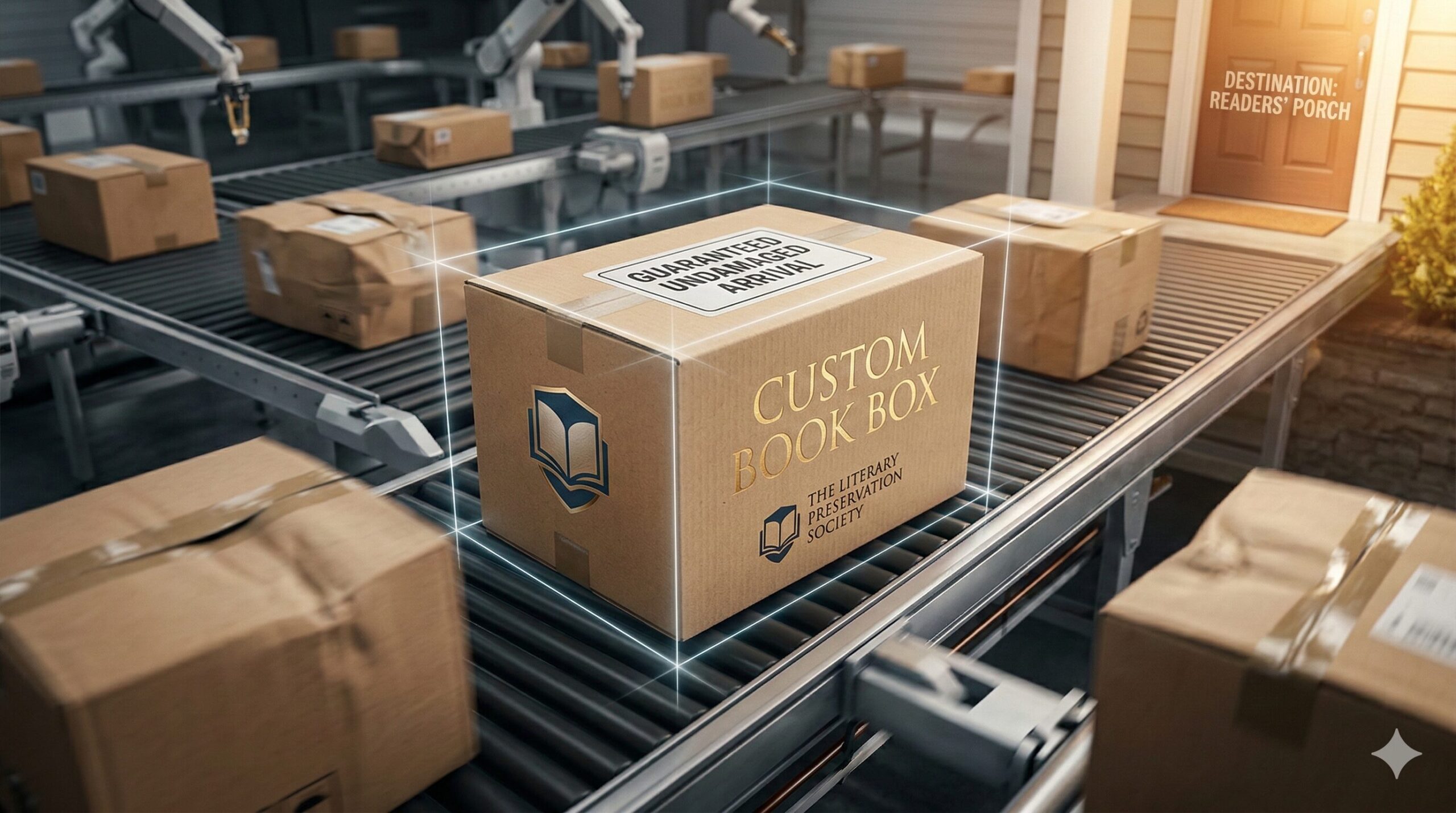
In the modern era of custom book boxes e-commerce supply chain, printed literature occupies a uniquely vulnerable logistical niche. Physical books are exceptionally susceptible to kinetic impacts and hygroscopic warping. A crushed spine, bumped corner, or moisture-wavy pages instantly destroys a product’s retail value and compromises customer retention. For publishers, booksellers, and independent authors, utilizing highly engineered custom book boxes is the definitive method to neutralize the frictional hazards of automated parcel networks.
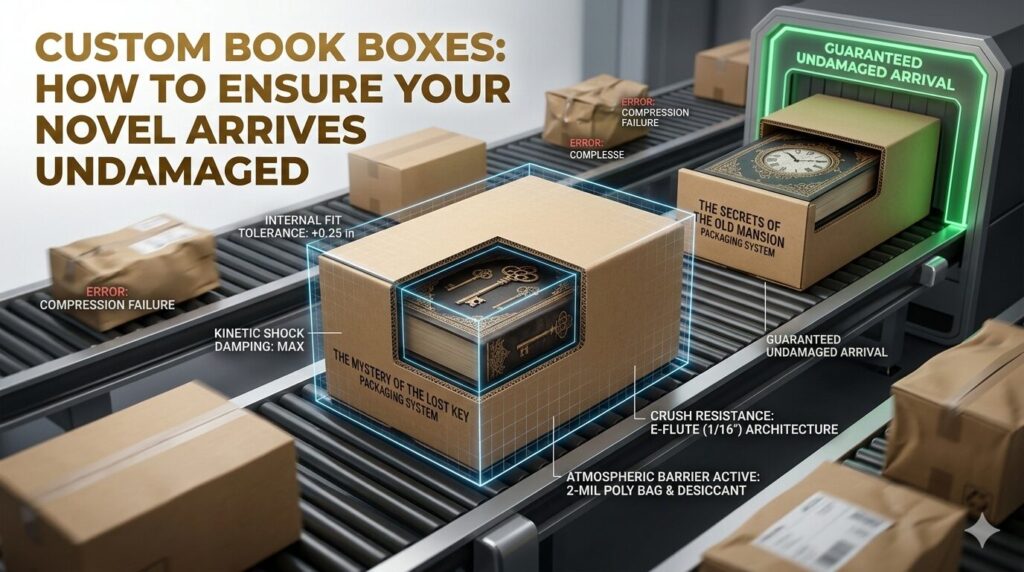
Quick Answer: How do you prevent shipping damage for novels? To ensure a novel arrives undamaged, utilize custom book boxes constructed from E-flute corrugated cardboard (1/16″ thick). Size the internal dimensions with exactly a 0.25-inch tolerance to prevent lateral shifting, isolate the text block in a 2-mil polyethylene bag for moisture defense, and use biodegradable honeycomb paper or suspension inserts to absorb kinetic shock.
The Macroeconomics of Literary Shipping Damage
The financial devastation wrought by inadequate packaging is severe. Data from 2024 reveals that 85 million e-commerce packages arrived damaged in the United States, with 3% to 4% of all shipped packages suffering structural compromise. While the publishing sector maintains a remarkably low overall return rate of 5.8%, a staggering 67% of book returns are triggered exclusively by shipping damage.
Replacing a single compromised novel costs a business $10 to $20 in reverse logistics, repackaging, and administrative overhead. Furthermore, 51% of consumers state they will not make a repeat purchase after receiving a damaged product. Investing in structurally rigid custom book boxes directly protects profit margins by eliminating these preventable mechanical failures.
Material Science and E-Flute Architecture
The foundational element of literary preservation is the external barrier. Standard corrugated material consists of two flat linerboards glued to an inner fluted medium. For single-volume shipping, E-flute corrugated board is the strictly favored industry standard for custom book boxes. Featuring approximately 90 flutes per square foot and a highly compressed 1/16-inch profile, E-flute delivers immense crush resistance without adding unnecessary volumetric weight.
For premium subscription models or luxury limited editions, publishers frequently upgrade to Solid Bleached Sulfate (SBS) paperboard. This chemically bleached substrate provides a pristine white canvas for high-resolution CMYK graphics, spot UV, and tactile foil stamping.
Precision Sizing and The 0.25-Inch Rule
A protective enclosure is only effective if its dimensions are mathematically precise. Internal movement equates directly to kinetic damage during transit. When engineering custom book boxes, operators must prioritize internal dimensions (Length × Width × Depth). A strict tolerance of exactly 0.25 inches must be added to the book’s exact physical footprint, measured using digital calipers.
This specific volumetric buffer prevents friction damage to delicate dust jackets and severe strain on glued bindings without allowing the novel to build momentum during sudden drops. Utilizing these precise sizing calculations matches the rigorous load-bearing tolerances applied when designing heavy-duty corrugated shipping boxes for industrial transport.
Void Fill Dynamics and Corner Protection
If standard corrugated cartons are used instead of form-fitting retention mailers, internal void fill becomes mandatory to immobilize the text block. The industry is rapidly pivoting away from toxic expanded polystyrene. Die-cut honeycomb silk paper (like Geami WrapPak) or 100% biodegradable starch-based packing peanuts successfully absorb shock while aligning with modern eco-friendly mailer box initiatives.
Furthermore, heavy palletized shipments require rigid cardboard edge protection (such as VBoard). Unlike foam corner protectors, which compress and flatten under sustained loads, multi-ply cardboard maintains a rigid 90-degree angle on the exterior of custom book boxes, fighting compressive forces and preventing plastic strapping from biting into the packaging.
Atmospheric Hazard Mitigation
Paper is highly hygroscopic, constantly absorbing and releasing moisture to reach an equilibrium with its environment. During long-distance or cross-border freight, sealed shipping containers experience severe temperature fluctuations. This causes internal moisture to condense into water droplets—a destructive phenomenon known as “container rain.”
To mitigate this hazard before insertion into custom book boxes, novels must be isolated within a waterproof 2-mil poly bag or vacuum-sealed shrink wrap. For extended ocean transit, inserting calcium chloride desiccants actively lowers the package’s internal dew point. As documented by the Swell global shipping ecommerce statistics, comprehensive atmospheric and structural packaging protocols are a non-negotiable requirement for successful international fulfillment.