
Category: Custom Mailer Boxes Reading Time: 4 Minutes
In the contemporary direct-to-consumer (DTC) supply chain, packaging cannot be treated as a generic commodity. It is a highly engineered structural asset designed to survive the severe friction of automated logistics networks while simultaneously preserving product integrity and brand presentation. At the core of this fulfillment ecosystem are corrugated mailer boxes, which utilize a sophisticated three-ply paperboard architecture. The most critical variable in determining both the physical performance and the logistical cost of these containers is the specific flute profile—namely, the strategic choice between E-Flute and B-Flute corrugated mediums.
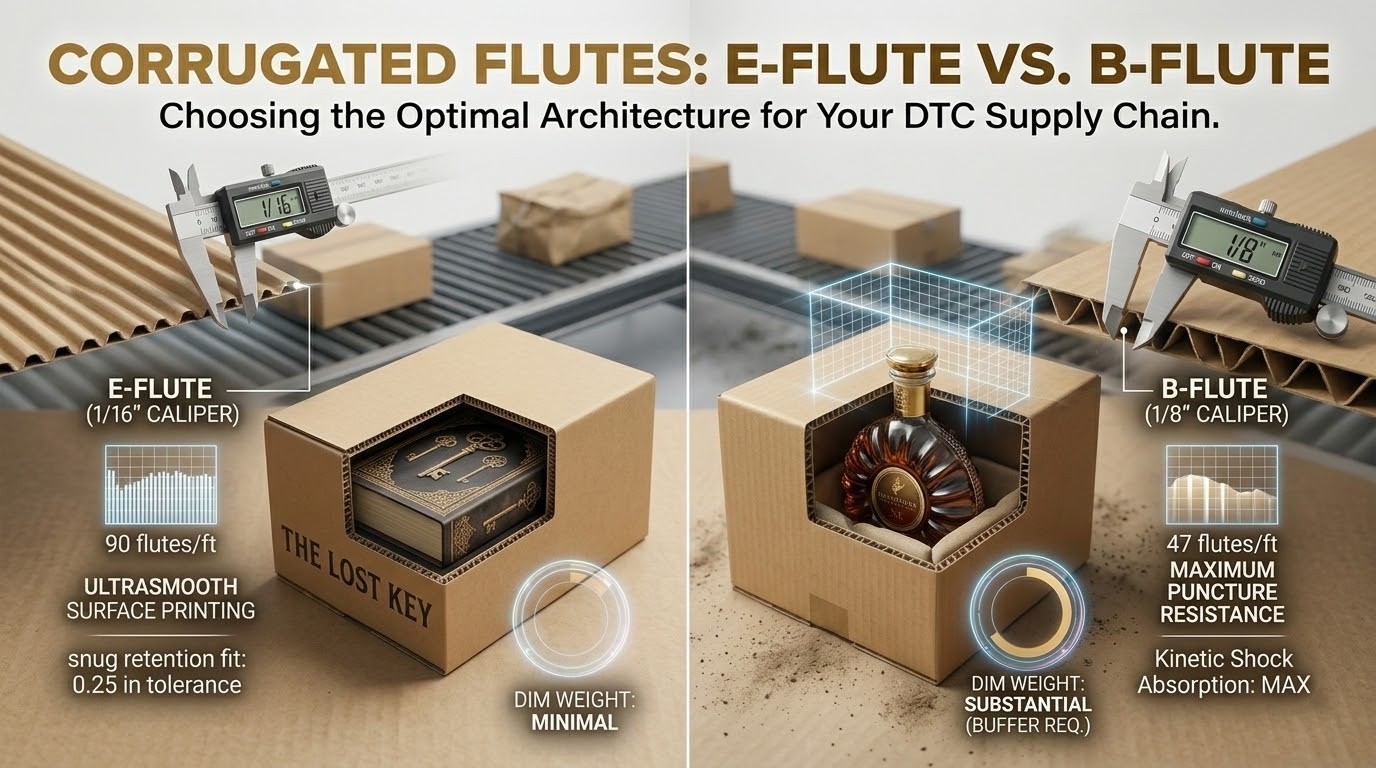
Quick Answer: Should you utilize E-Flute or B-Flute? Select E-Flute (1/16″ thickness) for lightweight retail products, cosmetics, and subscription kits where high-resolution printing and low dimensional weight are operational priorities. Select B-Flute (1/8″ thickness) when shipping heavier items that strictly require maximum puncture resistance and enhanced internal shock absorption.
The Mechanics of Corrugated Fluting
To optimize supply chain economics, one must first understand corrugated material anatomy. Standard corrugated board consists of two flat outer linerboards encasing a wavy, arched inner medium known as the fluting. This specific geometry is designed to resist vertical compression and lateral crushing forces. However, all flutes are not engineered equally. The frequency (flutes per linear foot) and the caliper (overall thickness) dictate the board’s structural behavior. Deploying corrugated mailer boxes without analyzing these precise mechanical variables leads directly to elevated damage rates or bloated shipping tariffs.
E-Flute Architecture: Precision and Print Fidelity
E-Flute represents the industry standard for premium, retail-ready e-commerce packaging. Measuring approximately 1/16 of an inch in thickness and featuring roughly 90 flutes per linear foot, this profile provides an exceptionally flat, uniform exterior surface. This high structural density drastically reduces the “washboarding” effect (visible ridges) during offset lithography or high-speed digital printing. Consequently, E-Flute is the superior choice for high-fidelity brand graphics and intricate typography.
Furthermore, the slim profile of E-Flute yields mathematically exact internal tolerances. This physical precision is identical to the strict parameters utilized when engineering custom book boxes to ensure a novel arrives undamaged, preventing lateral shifting and kinetic transit damage during the final mile of delivery.
B-Flute Architecture: Maximum Kinetic Absorption
Conversely, B-Flute is engineered for heavier, high-impact transit demands. Measuring roughly 1/8 of an inch thick with approximately 47 flutes per linear foot, B-Flute sacrifices a perfectly smooth printing canvas in exchange for superior physical protection. The taller, broader arches provide aggressive vertical crush resistance and exceptional puncture defense against automated sorting machinery and palletized stacking.
When determining the necessary burst strength and Edge Crush Test (ECT) ratings for heavy-duty shipments, supply chain directors frequently benchmark their corrugated mailer boxes against the standardized structural and load-bearing guidelines published by the official Fibre Box Association (FBA).
Dimensional Weight (DIM) and Economic Viability
The choice between E-Flute and B-Flute directly impacts a brand’s fulfillment profitability through Dimensional Weight (DIM) pricing. Because modern parcel carriers (UPS, FedEx, USPS) calculate shipping costs based on the volumetric space a parcel occupies rather than its actual scale weight, deploying thicker packaging mathematically inflates shipping tariffs. A B-flute unit requires significantly more cubic volume than an E-flute unit of the exact same internal capacity.
For high-volume sellers, switching to an E-Flute profile can slash cubic freight metrics, saving thousands of dollars in annual logistics overhead. Operators analyzing these specific logistical metrics must cross-reference their flute selection with broader structural decisions, such as those evaluated in our framework on corrugated shipping boxes: single wall vs. double wall strength.
Strategic Deployment
Selecting the correct flute architecture requires a clinical analysis of product weight, aesthetic requirements, and spatial economics. Over-engineering with B-Flute wastes critical working capital on volumetric freight penalties, while under-engineering with E-Flute risks complete product destruction. By executing a calculated material strategy, corrugated mailer boxes transform from a mandatory operational expense into a highly optimized, profit-preserving logistics mechanism. Ensure your fulfillment architecture is fully calibrated to your product’s requirements by exploring our precision-engineered custom mailer boxes configurations.