The physical retail environment operates within a landscape of strict spatial limitations and volatile consumer attention spans. For emerging brands attempting to capture market share against established conglomerates, securing premium inline shelf placement is frequently financially prohibitive. The strategic integration of highly engineered cardboard display boxes neutralizes this disadvantage by transforming generic checkout counters and empty endcaps into proprietary merchandising real estate.
Quick Answer: Why are cardboard display boxes the optimal merchandising strategy for small brands? Cardboard display boxes provide an exceptional return on investment (ROI) by leveraging high-strength, low-cost corrugated substrates to stimulate impulse purchases. By placing products directly at the Point-of-Sale (POS), small brands bypass standard aisle competition. Utilizing lightweight, flat-shipped structural designs significantly reduces dimensional weight freight penalties while maximizing brand visibility and retail footprint.
The Macroeconomics of Impulse Merchandising
In standard retail operations, consumer purchasing behavior is heavily dictated by proximity to the transaction register. Industry data indicates that up to 68% of all in-store purchases are driven by impulse, with the highest conversion rates occurring within the final queuing area. Without physical structures to hold inventory at these critical touchpoints, small brands forfeit massive revenue potential.
Deploying specialized cardboard display boxes capitalizes on consumer decision fatigue. When a shopper reaches the checkout, a strategically placed display utilizing high-contrast typography and precise visual architecture directly intercepts their line of sight. This mechanically forces an engagement loop that isolated, mid-aisle placement simply cannot achieve, instantly accelerating product turnover.
Material Science and Substrate Economics
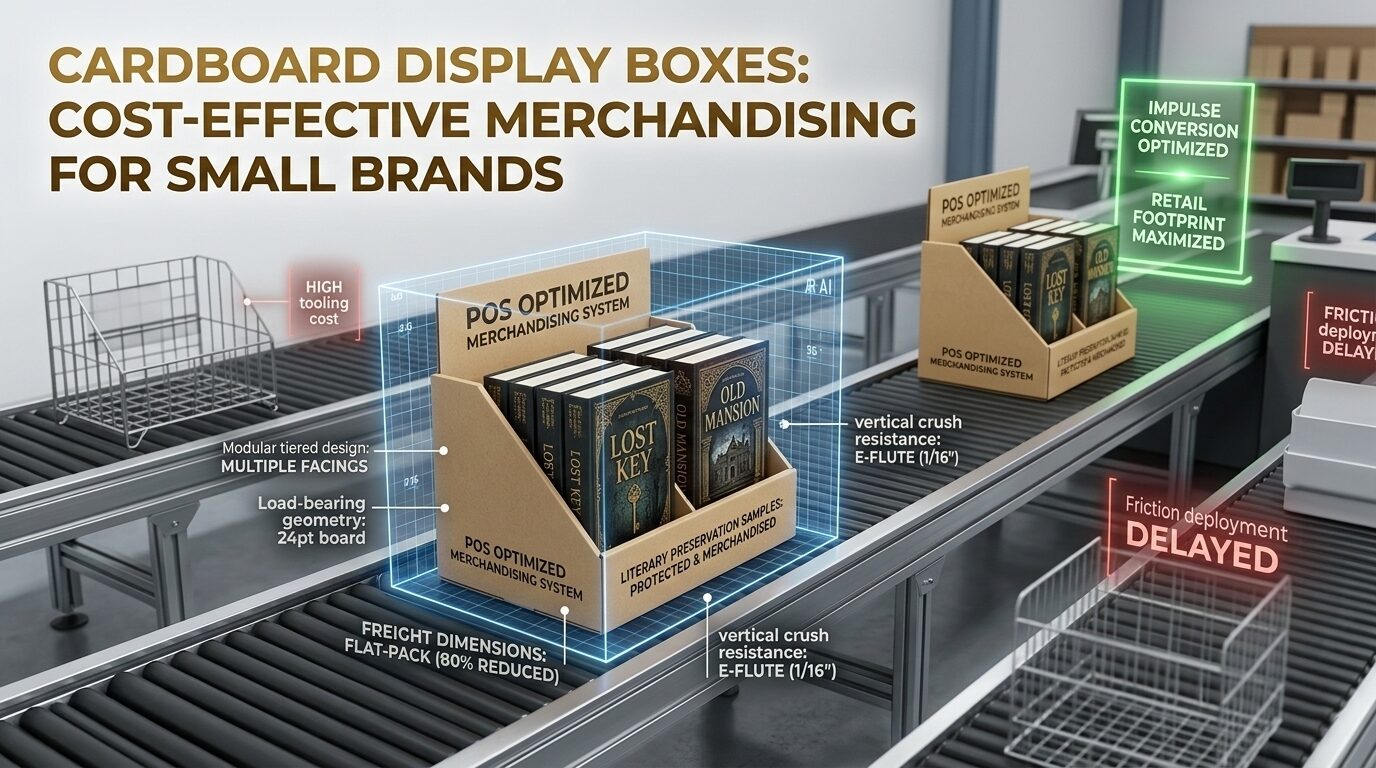
The fundamental profitability of cardboard display boxes stems from their specific structural composition. Unlike permanent acrylic or welded wire displays that require exorbitant tooling costs and complex, labor-intensive assembly, paperboard and corrugated solutions rely on highly accessible material science. Standard temporary displays are engineered using E-flute or B-flute corrugated cardboard. The fluted interior medium provides maximum vertical crush resistance and load-bearing capacity, ensuring the display does not collapse under the weight of glass bottles, cosmetics, or dense retail goods.
Simultaneously, the exterior linerboards act as a pristine canvas for offset lithography or high-speed digital printing. This facilitates photorealistic branding without the prohibitive setup fees historically associated with metal or plastic fabrication. To ensure compliance with modern retail guidelines and load-bearing safety, brands frequently design these units using the strict physical protocols established by the official Shop! Environments Association, guaranteeing both structural integrity and supply chain uniformity.
Structural Engineering for Shelf Optimization
The physical footprint of a merchandising unit directly dictates retailer acceptance. Store managers actively reject bulky, inefficient displays that consume excess counter space or disrupt checkout flow. Precision-engineered cardboard display boxes utilize modular tiers, gravity-feed dispensers, and automated pop-up bases to maximize product density within a minimal cubic footprint.
By utilizing a die-cut step design, a brand can showcase multiple product facings simultaneously without expanding the base parameter. When configuring these specific structural parameters, operators must implement the exact load-bearing geometry utilized in heavy-duty custom display boxes. This strict mathematical tolerance prevents lateral shifting during transit, ensuring the unit arrives at the retailer pristine and ready for immediate deployment.
Strategic Sourcing and Supply Chain ROI
From a logistics perspective, the true cost of retail merchandising is heavily influenced by freight dimensions. Permanent metal displays must be shipped fully assembled, incurring massive dimensional weight (DIM) shipping penalties from carriers. Conversely, cardboard display boxes are manufactured to ship completely flat. A single pallet can transport hundreds of flat-packed corrugated units, slashing logistics expenses by up to 80% compared to rigid alternatives.
Upon arrival, advanced fold-and-lock dielines allow retail staff to erect the display in seconds without adhesives or specialized tools. This rapid deployment eliminates retailer friction. By synthesizing lightweight corrugated architecture, high-impact localized printing, and flat-pack logistics, sourcing cardboard display boxes allows small brands to penetrate new physical markets efficiently. This methodology seamlessly integrates with broader custom retail boxes strategies, establishing a cohesive physical presence that drives immediate consumer conversion and maximizes operational profit margins.