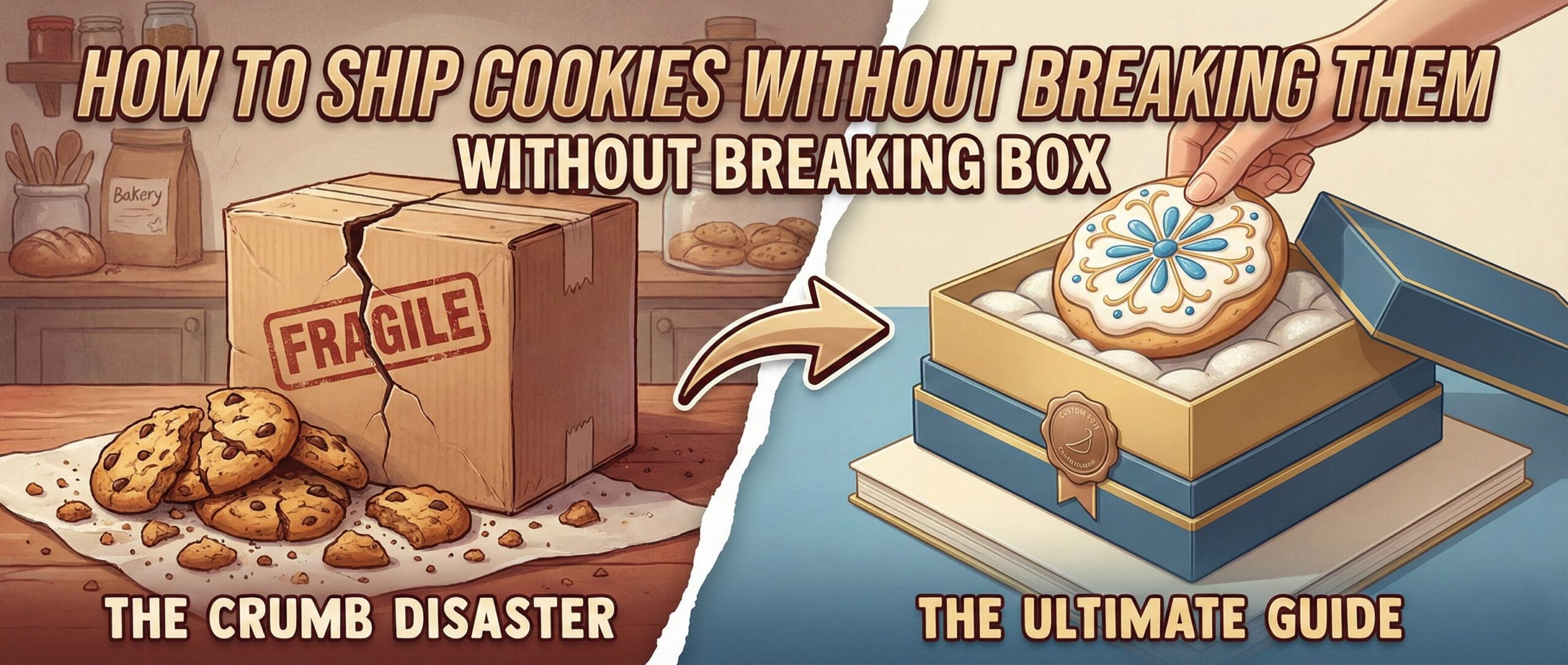
The process of shipping cookies in the cookie box, while seemingly straightforward, involves a sophisticated interplay of structural mechanics, chemical engineering, and thermodynamic management. In the context of long-distance transit, cookies are treated not as food but as fragile structural units.
When shipping cookies in a Cookie Box, ensure that all elements are optimized for protection.
A well-designed Cookie Box can prevent damage and enhance the overall delivery experience.
If your customers are receiving shattered crumbs or soggy biscuits, the failure usually isn’t the courier—it is a breakdown in packaging engineering. This guide outlines the exact professional protocols required to mitigate mechanical failure and biological degradation during transit.
Using a Cookie Box helps maintain optimal cookie freshness during transit.
The Thermodynamics of Cooling: Preventing the “Sauna Effect”
Quick Answer: > Never package a warm cookie. Professional protocols require a minimum 120-minute cooling period at ambient temperature. Sealing a cookie before thermal equilibrium is reached causes residual internal heat to trigger evaporation, leading to condensation on the container walls (the “sauna effect”) which creates sogginess and promotes microbial proliferation.
Starch Retrogradation and Structural Setting
When a cookie exits the oven, it is in a malleable, quasi-liquid state where fats are molten and starch granules are fully gelatinized.
- Conductive Cooling: Professional standards dictate that drop cookies should remain on the baking sheet for exactly five minutes post-extraction. This allows for conductive heat loss to the metal pan, facilitating a gentle setting of the base.
+1 - Convective Cooling: Cookies must then be transferred to a grid-pattern cooling rack with half-inch apertures. This configuration maximizes convective heat transfer by allowing air to circulate across all surfaces, preventing steam accumulation on the underside. As the temperature drops, the starches undergo retrogradation, forming a crystalline structure that provides the cookie with its final rigidity.
Primary Barrier Systems: The “Back-to-Back” Protocol
Consider the type of Cookie Box that best suits your cookies to avoid flavor transfer.
Quick Answer: > Individually wrapping cookies prevents “flavor transfer” between different varieties. To maximize structural integrity against bending stress, utilize “back-to-back” wrapping, where two cookies are placed with their flat bottoms together before being sealed in BOPP (Cellophane) or plastic wrap.
The right Cookie Box design will significantly enhance the protection of thin cookies during shipping.
Doubling the Resistance
Thin or crispy cookies possess low structural durability and a high likelihood of shattering under drop impacts.
- Wrapping two cookies back-to-back creates a double-thickness unit that possesses a significantly higher resistance to snapping under bending stress than a single cookie.
- By doing this in BOPP or PVC, you double the cross-sectional area for strength while providing a primary barrier against oxidation and moisture migration.
For optimal protection, select a Cookie Box that meets industry standards.
Ensure your Cookie Box is constructed to prevent mechanical failure during transit.
Container Architecture and the 3-Ply Cookie Box Spec
Quick Answer: > The industry gold standard is the “box-within-a-box” method utilizing a 3-ply corrugated kraft box. The primary inner container should be packed using a “heavy-to-light” stacking protocol and placed inside a corrugated box that is at least two inches larger in all directions, filling the void with dunnage to dissipate kinetic energy. Before finalizing your 3-ply corrugated structure, verify that your void-fill density complies with official UPS perishable shipping guidelinesto ensure your claim is not denied in the event of severe mechanical crush damage.
Internal Stacking and Void Fill
Within your primary metal tin or hard plastic box, organization is critical.
- A “heavy-to-light” stacking protocol must be observed.
- Heavier, more resilient items (like brownies) form the foundation, while lighter, fragile items (like meringues) are placed on top to minimize the compressive load they bear.
- Fill all remaining voids with non-reactive dunnage (bubble wrap, crumpled parchment) until a gentle shake results in no audible or tactile movement of the contents.
- the outer packaging must be engineered to pass rigorous custom shipping boxes drop test standards to prevent mechanical failure during transit.
The Corrugated Engineering Standard
The outer shipping box must act as a shock absorber. To survive high-velocity sortation networks, professional e-commerce specifies the following 3-ply corrugated components:
Utilizing a Cookie Box with proper engineering can save your business from costly damages.
- Top Liner: 450gsm Kraft Card for puncture resistance and structural rigidity.
- Fluting (Middle): 150gsm Corrugated Medium for shock absorption and vertical stack strength.
- Bottom Liner: 160gsm Liner Paper for internal burst protection.
- The Mechanical Buffer: Maintain 2 inches of dunnage between the primary container and the secondary corrugated box to provide a deceleration distance that dissipates shock.
Ready to scale your bakery’s e-commerce operations?
While paper bags provide cost-effective quality for walk-in retail, e-commerce requires structural rigidity; understanding how to ship cookies without breaking them requires a transition from flexible bags to 3-ply corrugated box architectures.
Protect your brand reputation and eliminate damage claims by upgrading your transit logistics with our premium wholesale custom bakery boxes, engineered specifically for shock absorption and thermal stability.
Investing in a high-quality Cookie Box is essential for maintaining your brand’s reputation. Explore options for a Cookie Box that provides shock absorption and thermal stability.